

The Importance of Reliable Power Backup
Electricity is the backbone of modern businesses and industrial operations. From manufacturing facilities and hospitals to IT infrastructure, data centres and commercial establishments, uninterrupted power is essential for maintaining productivity and operational continuity.
Unexpected power failures, voltage fluctuations and electrical disturbances can damage sensitive equipment, interrupt business operations and cause significant financial losses.
An Uninterruptible Power Supply (UPS) system provides a dependable power backup solution by maintaining a continuous and regulated electricity supply to critical equipment during power interruptions.
Northern Electrical Power Engineering Solution Pvt. Ltd. (Northern EPES) specialises in UPS systems, industrial battery solutions and electrical engineering services. We provide customised power backup solutions designed to meet the requirements of commercial, industrial and infrastructure applications.
Our solutions cover UPS capacities from 1 KVA to 1000 KVA, with battery configurations designed according to load requirements and backup duration. 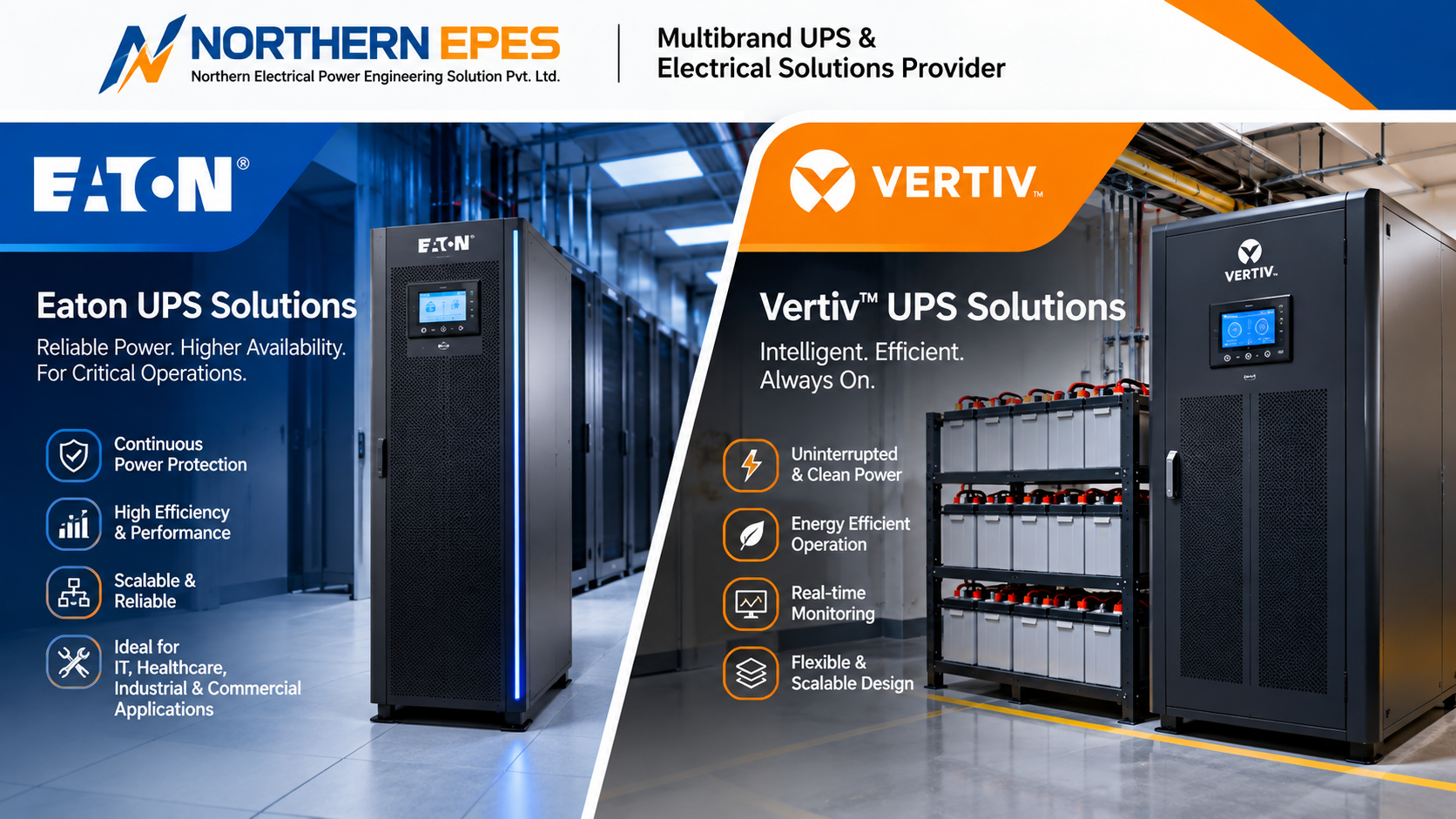
1. What Is an Uninterruptible Power Supply (UPS)?
An Uninterruptible Power Supply (UPS) is an electrical device that provides temporary backup power when the main electricity supply fails or becomes unstable.
A UPS also helps protect sensitive electrical and electronic equipment against various power disturbances, depending on the UPS topology and design.
Main Components of a UPS System
1. Rectifier: Converts incoming AC power into DC power for the DC bus and battery charging.
2. Battery Bank: Stores electrical energy and supplies DC power when the main electricity supply is interrupted.
3. Inverter: Converts DC power into regulated AC output for connected equipment.
4. Static Bypass: Provides an alternative supply path when the UPS transfers to bypass operation under specified conditions.
5. Control and Monitoring System: Monitors operating parameters, battery status, alarms and UPS performance.
How Does a UPS Work?
During normal operation, the UPS receives electricity from the main power supply and provides conditioned power to connected equipment. The battery bank remains charged and ready for operation.
When the main power supply fails, the UPS uses stored battery energy to maintain the output supply without interruption in online double-conversion operation.
This makes UPS systems essential for applications where even a short power interruption can affect business operations.
2. Different Types of UPS Systems
Selecting the correct UPS technology is important for achieving reliable power protection.
A. Online Double Conversion UPS
Online double-conversion UPS systems are designed for critical applications that require continuous and regulated power.
The incoming AC supply is converted into DC through the rectifier and subsequently converted back into AC through the inverter.
Key advantages:
Continuous power conditioning.
Protection against voltage fluctuations.
Stable and regulated output.
No-break transfer to battery operation during normal inverter operation.
Suitable for critical electrical loads.
Applications:
Data centres and server rooms.
Hospitals and healthcare facilities.
Industrial automation.
Manufacturing plants.
IT and communication infrastructure.
B. Line Interactive UPS
Line-interactive UPS systems provide battery backup along with voltage regulation through an automatic voltage regulator.
Key advantages:
Voltage regulation.
Battery backup during power failure.
Suitable for small and medium electrical loads.
Cost-effective power protection.
Applications:
Small offices.
Networking equipment.
Workstations.
Commercial establishments.
C. Offline / Standby UPS
Offline UPS systems generally supply the connected load directly from the mains during normal operation and switch to battery-powered inverter output when the mains supply fails.
Applications:
Personal computers.
Small office equipment.
Basic electronic equipment.
The appropriate UPS topology should be selected based on load criticality, electrical conditions, operating requirements and budget.
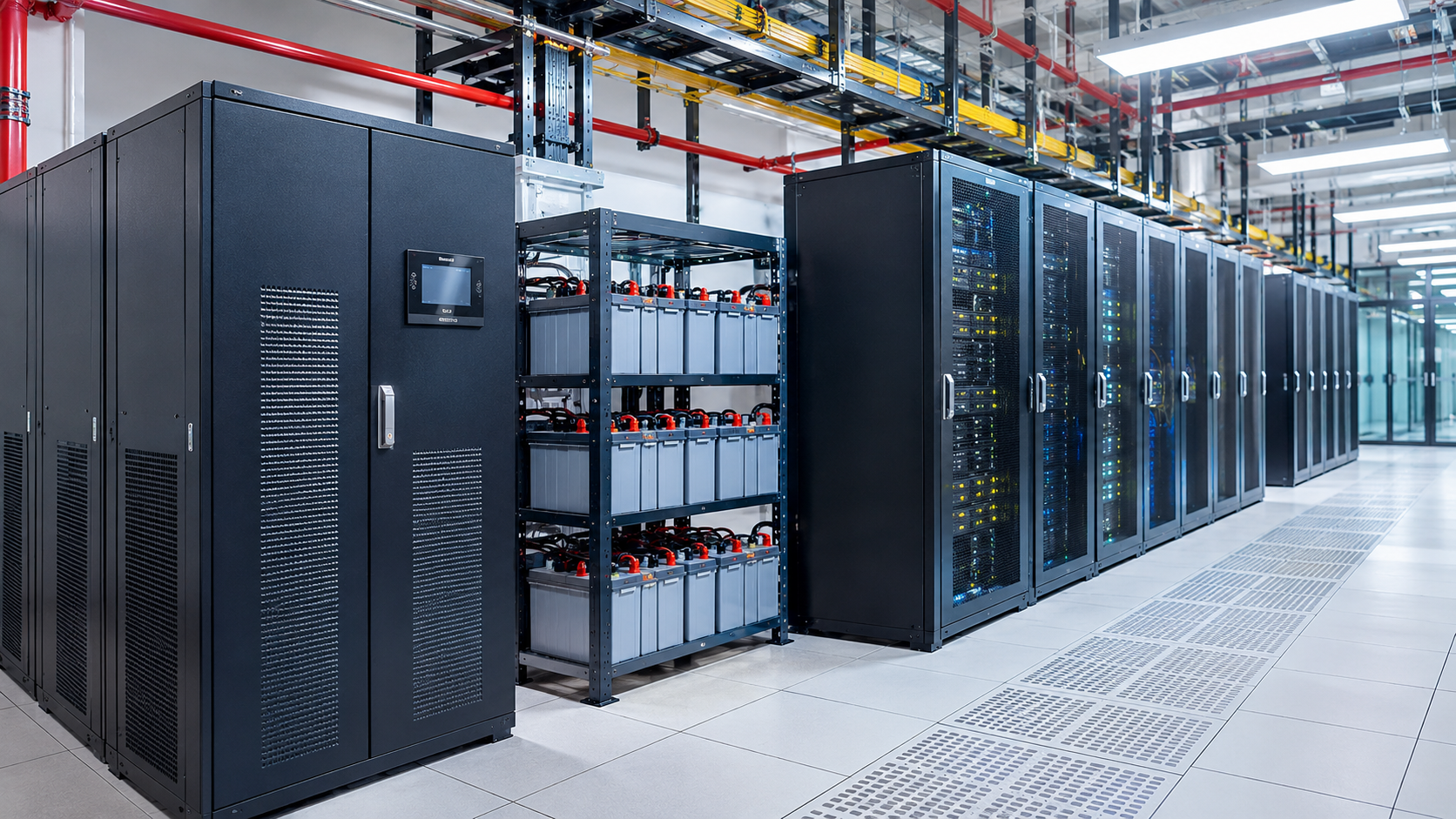 Online UPS and battery backup configuration for critical electrical applications.
3. Understanding Different UPS Battery Technologies
The battery bank is one of the most important components of a UPS system because it determines how long the connected equipment can operate during a power interruption.
Battery selection depends on backup duration, operating temperature, installation space, maintenance requirements and lifecycle cost.
A. VRLA / SMF Batteries
Valve Regulated Lead Acid (VRLA) batteries, including Sealed Maintenance Free (SMF) batteries, are widely used in UPS applications.
Advantages:
Low routine maintenance requirements.
Easy installation.
Available in different voltage and AH capacities.
Suitable for commercial and industrial UPS systems.
Established battery technology.
B. Lithium-Ion Batteries
Lithium-ion battery technology is increasingly being adopted for applications requiring compact energy storage and improved lifecycle performance.
Advantages:
Higher energy density.
Reduced installation footprint.
Potentially longer cycle life.
Faster charging capability, depending on system design.
Integrated Battery Management System (BMS) options.
Lithium-ion batteries require compatible UPS equipment, suitable BMS communication and correctly engineered battery protection.
Which Battery Is Suitable for Your UPS?
The right battery depends on the UPS rating, DC bus voltage, required backup duration, discharge characteristics, installation conditions and project budget.
A technical assessment should be conducted before finalising the battery configuration.
4. How to Select the Correct UPS Capacity?
Selecting the correct UPS capacity is essential for ensuring reliable operation and avoiding unnecessary investment.
UPS capacity is generally expressed in KVA and KW.
Before selecting a UPS, the following parameters should be considered:
Total connected electrical load.
UPS output power factor.
Critical and non-critical loads.
Starting and inrush currents.
Future load expansion.
Required battery backup duration.
Installation environment and operating temperature.
Redundancy requirements.
Example of UPS Capacity Calculation
Suppose an industrial facility has a critical connected load of 20 KW.
If the UPS output power factor is 0.9:
UPS Capacity = Load in KW / Output Power Factor
UPS Capacity = 20 / 0.9
UPS Capacity = 22.22 KVA
A suitable higher UPS rating should be selected after considering the required design margin, load characteristics and future expansion.
The final selection must be verified against the manufacturer's specifications.
5. How to Calculate UPS Battery Backup Time?
Battery backup duration depends on the connected load, battery voltage, battery AH capacity, number of batteries, UPS efficiency and battery discharge characteristics.
A simplified theoretical calculation is:
Battery Energy (Wh) = Battery Voltage × Battery Capacity (Ah)
For example:
A 12V, 100Ah battery has a nominal energy capacity of:
12 × 100 = 1,200 Wh
However, the actual usable energy is lower and depends on discharge rate, temperature, battery technology, allowable depth of discharge and inverter efficiency.
For accurate industrial battery sizing, engineers must consider:
UPS DC bus voltage.
Battery string configuration.
Required backup time.
Battery discharge tables.
End-of-discharge voltage.
Battery ageing allowance.
Operating temperature.
Charging compatibility.
Important: Battery sizing should always be verified using the UPS manufacturer's technical specifications and battery manufacturer's discharge data.
6. Applications of UPS Systems Across Different Industries
UPS systems play an important role in protecting critical electrical infrastructure.
Healthcare and Hospitals
UPS systems support critical medical equipment, diagnostic systems, patient monitoring equipment and essential IT infrastructure.
Data Centres and IT Infrastructure
Data centres depend on reliable UPS systems to protect servers, networking equipment, storage systems and communication infrastructure.
Manufacturing Industries
Industrial UPS systems support PLCs, automation systems, control panels, instrumentation and critical manufacturing processes.
Commercial Buildings
UPS solutions provide backup for security systems, access control, communication systems and essential IT equipment.
Infrastructure and Utilities
UPS systems support critical monitoring, control, communication and electrical infrastructure applications.
 Reliable UPS power protection for industrial, commercial and IT infrastructure.
7. Importance of UPS Preventive Maintenance and AMC Services
Installing a UPS system is only the first step. Regular preventive maintenance is essential to maintain equipment reliability and identify potential problems before they cause unexpected failures.
A professional UPS Annual Maintenance Contract (AMC) can include:
UPS health inspection.
Battery voltage measurement.
Battery terminal and interconnection inspection.
Battery impedance or conductance testing, where appropriate.
Cooling fan inspection.
UPS alarm and event-log review.
Rectifier and inverter parameter checks.
Electrical connection inspection.
Operational and functional testing.
Preventive maintenance reports.
Regular battery testing also helps identify deteriorating battery performance and plan replacements before a failure occurs.
[INSERT IMAGE 4: Electrical engineer inspecting UPS battery bank]
Image caption: Professional UPS and battery preventive maintenance to improve system reliability.
8. Why Choose Northern Electrical Power Engineering Solution Pvt. Ltd.?
Northern Electrical Power Engineering Solution Pvt. Ltd. (Northern EPES) provides comprehensive UPS, battery and electrical engineering solutions for commercial, industrial and infrastructure projects.
We focus on understanding the customer's electrical requirements and providing technically appropriate solutions.
Our Products and Services
UPS Systems
Online UPS systems from 1 KVA to 1000 KVA.
Industrial UPS systems.
Three-phase UPS solutions.
Customised power backup systems.
Battery Solutions
SMF / VRLA batteries.
Lithium-Ion battery solutions.
Industrial battery banks.
Battery chargers and accessories.
Electrical Engineering Services
HT and LT equipment supply and installation.
Transformer and RMU solutions.
DG set solutions.
Electrical installation and commissioning.
UPS and battery AMC services.
Electrical supply chain management.
Our Associated Brands
We offer products and solutions from leading manufacturers, subject to model availability and application suitability:
Our Commitment
Application-based technical selection.
Customised battery backup calculations.
Technical and commercial proposals.
Equipment supply and installation coordination.
Commissioning and preventive maintenance.
Project-based electrical engineering support.
With project experience across multiple locations in India, we aim to deliver reliable and technically suitable electrical power solutions.
⚡ Need Official Sizing & Price Quotation?
Speak directly with our senior power engineers for Vertiv, Eaton, Delta, Numeric Online UPS, Exide/Quanta battery banks, or 24/7 AMC across 50+ hubs in India.